
Dual-18″ bass systems
One application is one nominal 4Ω dual-18″ subwoofer cabinet per channel. Match cabinet power handling, minimum impedance and processor limiting to the chosen amplifier configuration.
One of our factory bestsellers. A two-channel amplifier platform for professional subwoofer applications, with private-label and deeper OEM / ODM options.
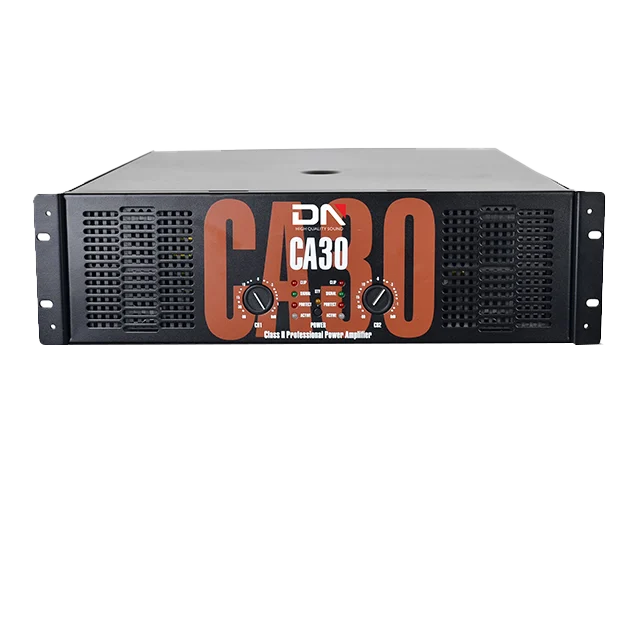
CA30 uses a Class H output stage. Its catalog ratings cover stereo operation at 8Ω, 4Ω and 2Ω, plus bridge-mono operation at 8Ω and 4Ω.
“2 ×” describes two stereo channels at the stated load. Bridge mono uses both channels as one output; its load requirements differ from stereo operation. Review the speaker load, wiring and limiting with the product team.
The catalog lists protection against short circuit, open circuit, overheating, overload, DC and ultrasonic-frequency conditions. Request the current manual and model-specific testing information for your evaluation.
Specifications transcribed from the supplied DN catalog, CA SERIES / printed page 13. Power values are catalog ratings; confirm test conditions and the current production configuration before ordering.
| Output stage | Class H |
|---|---|
| Channels | 2 |
| 8Ω stereo power | 2 × 1600 W |
| 4Ω stereo power | 2 × 2400 W |
| 2Ω stereo power | 2 × 3600 W |
| 8Ω bridge mono power | 4800 W |
| 4Ω bridge mono power | 6400 W |
| Frequency response | 20 Hz–20 kHz (±0.5 dB) |
| THD+N (8Ω, 1 kHz, ¼ output) | <0.05% |
| Signal-to-noise ratio | >80 dB |
| Damping factor (8Ω, 1 kHz) | >800 |
| Slew rate | >20 V/μs |
| Input sensitivity | 0.775 V / 1.0 V / 1.4 V |
| Input impedance (balanced / unbalanced) | 20 kΩ / 10 kΩ |
| Input connectors | 3-pin female XLR, electronically balanced |
| Link connectors | 3-pin male XLR |
| Net / gross weight | 38 kg / 42 kg |
Real supplied product photography. Select an image to inspect the original detail.
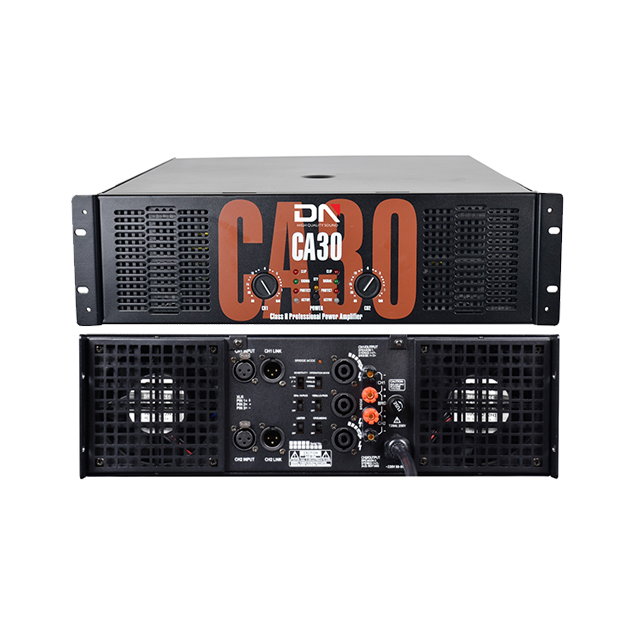
See the amplifier faceplate and rear connection layout. Discuss the panel artwork and connector configuration for your order.
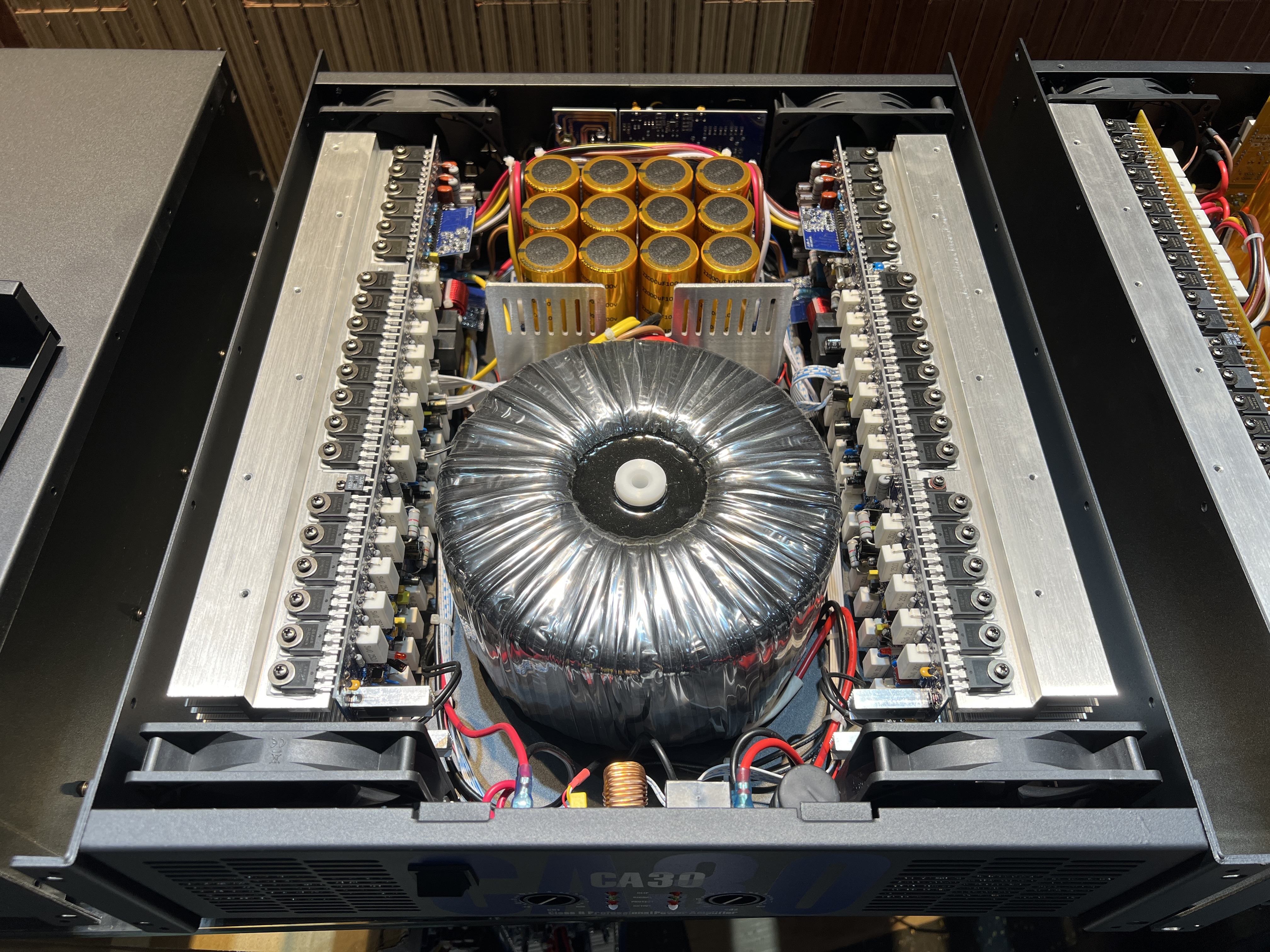
An open-chassis view of the transformer, capacitor banks and output-stage layout. Use the actual construction photo as a starting point for sample review.
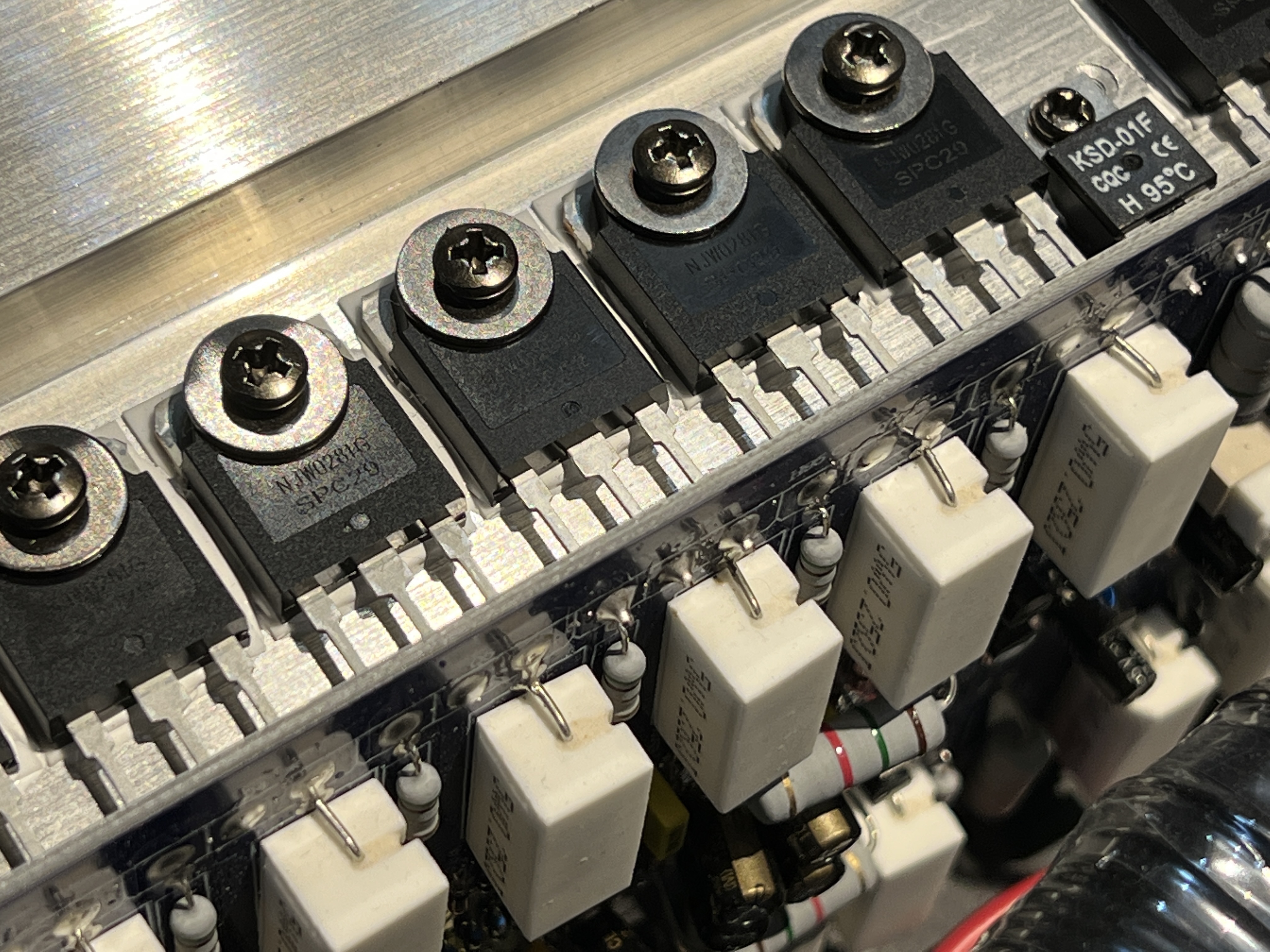
A close look at the installed output devices and their mounting. Component and configuration requirements can be reviewed during OEM discussions.
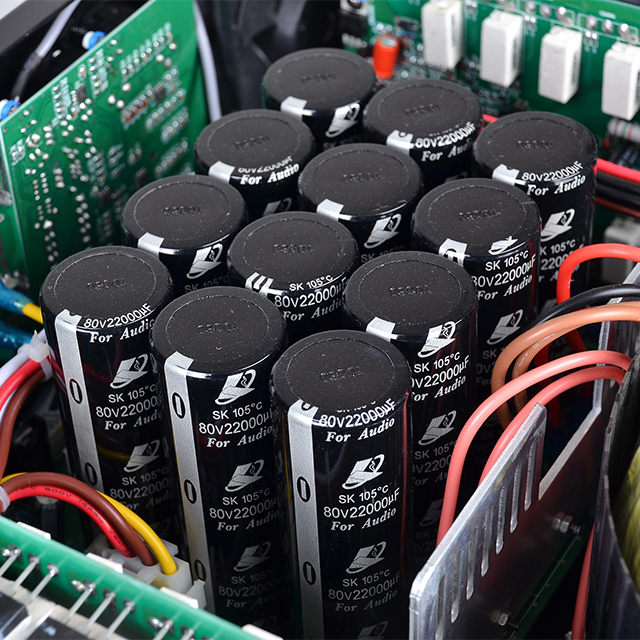
Original factory close-up of the power-supply area. Confirm the bill of materials and approved sample for your selected configuration.
Application guidance for product selection and system discussions.
One application is one nominal 4Ω dual-18″ subwoofer cabinet per channel. Match cabinet power handling, minimum impedance and processor limiting to the chosen amplifier configuration.
Consider CA30 for dedicated low-frequency channels in event and rental systems. Plan mains distribution, rack ventilation and the complete loudspeaker load before operation.
Use the CA30 platform as a starting point for a brand-owned amplifier range. Discuss logo, panel, packaging, sample approval and longer-term product requirements.
Conceptual signal path, not a wiring diagram. Final suitability depends on the speaker load, processing, AC supply and operating conditions. These are application examples, not customer installations.
Start with an existing CA30 platform and discuss logo, front-panel artwork and packaging. For deeper changes, share your target application, market requirements, specification priorities and estimated quantity.
01 · Review the model and configuration
02 · Define branding and customization
03 · Evaluate the sample and agreed test criteria
04 · Approve specification, artwork and production details
Send your application, speaker load, target market and quantity. Ask for current specifications, sample information or an ISE 2027 meeting in Barcelona.